

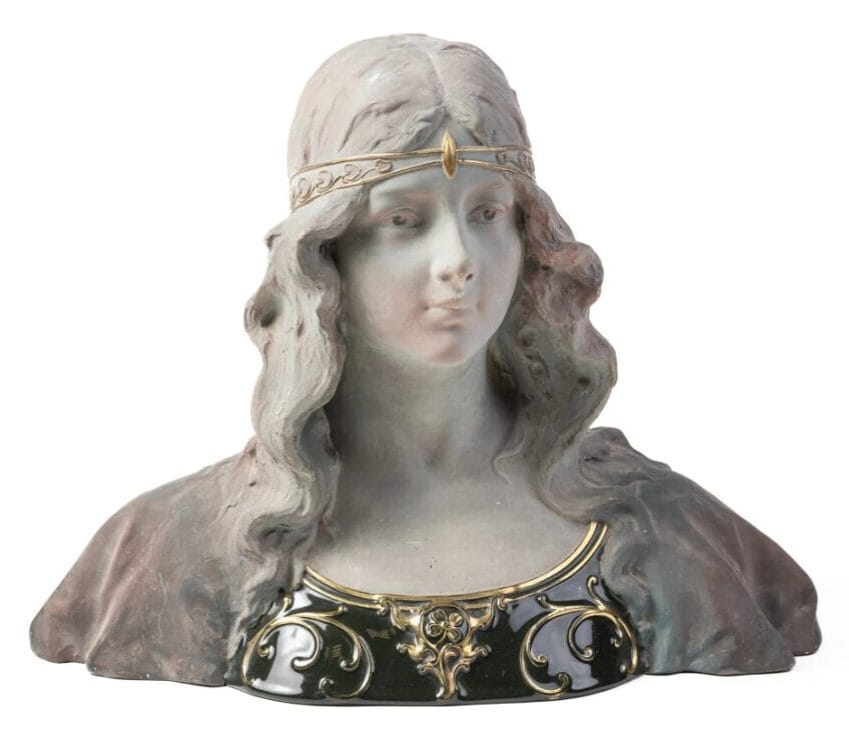
Art Nouveau Woman’s Bust – Elegant Stoneware, signed Henri Jacobs
$948.00
This superb art nouveau woman’s bust in enameled stoneware is signed by the sculptor Henri Jacobs and marked on the reverse Grès de Charenton. This sculpture depicts a noble warrior female in armor, reminiscent of Alfons Mucha’s style. It embodies all the symbolism of art nouveau: mystical femininity with Renaissance inspiration and vegetal representations of flowers and branches. The soft face and curved lines are a perfect combination of elegance. In very good condition, this sculpture testifies to the craftsmanship of Charenton stoneware. Henri Jacobs, a Belgian architect and sculptor, is the creator of a rich collection of busts of gentle and mystical elegant women.
Antique sculpture
This Art Nouveau woman’s bust in stoneware is signed Henri Jacobs. It fully embodies the Art Nouveau movement and celebrates feminine beauty and nature in all its forms.
This statue is made of enameled stoneware, modeled with great delicacy. The floral motif’s elegance and gentle curves are in line with the poetic decorative art of Alphonse Mucha, who was the master of the 1900 style, Belle Époque.
In his interpretation of the decorative codes of his era, the Belgian artist incorporates sinuous forms, vegetal lines, and the feminine ideal, which are symbols of harmony and spirituality.
Bust in Charenton sandstone
The embossed mark Grés de Charenton is on this sculpture, which is known for its high-quality firing and fine glazes.. The matte contrasts of the stoneware and the brilliance of the enamel create a dynamic texture.
Stoneware production in Charenton town near Paris spanned a hundred years, in the 19th century from 1821 to 1924. The factory, located between the Seine and the Marne rivers, was ideally situated in a region rich in ceramists. The water proximity was ideal for ceramic production and transport.
The factory was known as Charenton art stoneware during the Belle Époque until 1921. During the height of the art nouveau period, the numerous creations with the artists of the time were the result of quality production.
Jacobs, a Belgian sculptor active at the turn of the 20th century, distinguished himself in decorative sculpture and feminine figures, often imbued with softness and mysticism.
Henri Jacobs, artist and committed individual
The architect Jacobs, disciple of Victor Horta, designed numerous facades in the floral art nouveau style in Belgium. He particularly worked on schools, social housing, and sumptuous private residences. His art developed around deep secular, social, and progressive convictions. He aimed to contribute through the architecture of his schools to teach beauty and goodness to students and uplift society. He lived in Brussels (1864–1935).
Art Nouveau from Alfons Mucha
Mucha developed his decorative style by drawing inspiration from multiple sources: Japanese, Celtic, Islamic, Greek, Gothic, or Rococo motifs, which he combined with his Slavic roots.
From 1896, he incorporated elements from Moravian tradition – ornate dresses, flowers, botanical motifs – as well as halos inspired by Byzantine icons, reflecting his spiritual conception of l’art.
The fluid curves, the idealized feminine figures, and the floral profusion became the pillars of his aesthetic and influenced the artists of the Belle Époque, including Henri Jacobs.
Elegant feminine decor
In very good condition, this work blends Renaissance and art nouveau, offering a timeless emotion. It will perfectly integrate into a refined interior, alongside other 1900s period pieces.
The beauty and simplicity of this art nouveau female bust is a resemblance to the decorative sensibility of the early 20th century in Europe.
| Weight | 5 kg |
|---|---|
| Expertise | Signed by the sculptor Henri Jacobs and marked on the reverse Grès de Charenton |
| Matière | |
| Services | Take a look at all our elegant decorative pieces by visiting the store. Available and at your disposal, we are here on the contact page for details. Your purchases are protected by solid packaging and international deliveries are handled with great care. Finally, add us to your bookmarks to be the first to discover our newest arrivals. |
Be the first to review “Art Nouveau Woman’s Bust – Elegant Stoneware, signed Henri Jacobs”
Related products
Sculpture, bronze and ancient marble
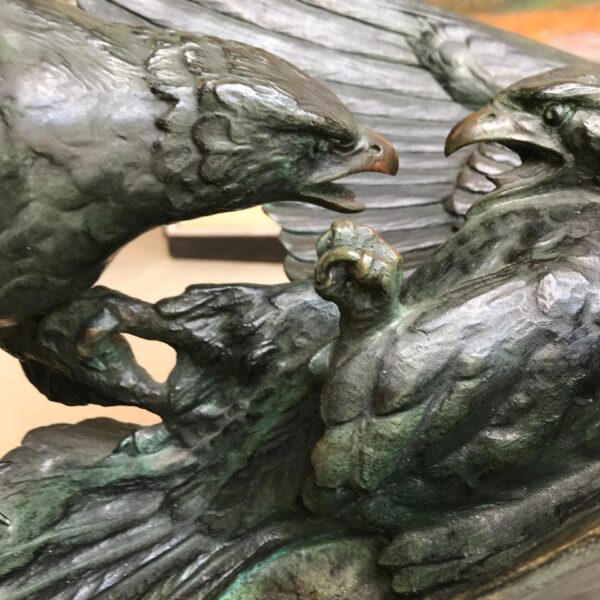
Eagle fight signed Louis Riché – Art Deco bronze sculpture with antique patina
Sculpture, bronze and ancient marble
Decorative Arts, Antiques
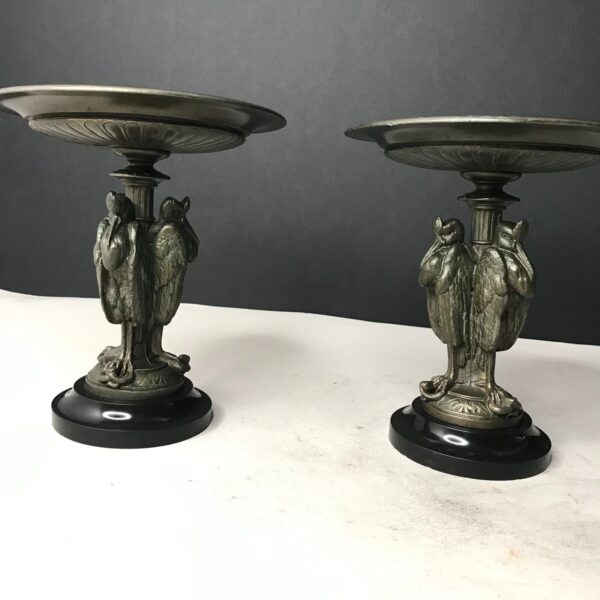
Antique 19th C. MARABOU Cassolettes, Patinated Bronze-Style Metal, Art Deco Vintage
Decorative Arts, Antiques
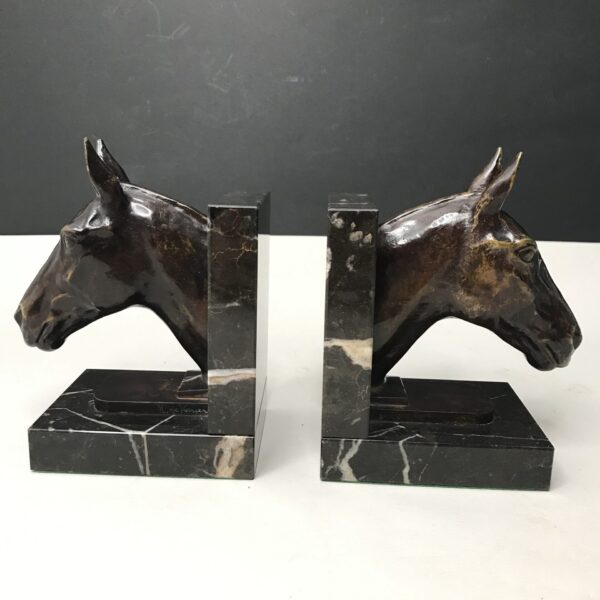
ART DECO HORSE BOOKENDS, Bronze, Signed Max LE VERRIER, Portor Marble, Vintage
Reviews
There are no reviews yet.